

Starmer’s government wants to give Muslims a special Islamophobia ‘tsar’, but it’s the Britain’s Jews who are EIGHT times more likely to be racially attacked than the next most targeted demographic
By Jeremy Wootliff & Alastair Kirk
In December 2025, the Prime Minister stated: “If what we do does not work for the Jewish community, then it does not work at all,” and pledged a broader action plan in the new year. We are writing this in mid-March 2026.
For Britain’s Jewish community, these delays feel painfully familiar. Reassurances such as “we must do more” or “this is a turning point” have been heard before, often without meaningful follow-through.
Meanwhile, the reality has worsened: Jews in Britain are now eight times more likely to be racially attacked than any other demographic per capita. This is not perception—it is a measurable crisis.
Frustration has reached a breaking point. As one senior Jewish community figure remarked, engaging with politicians can feel like “hitting our heads against a brick wall.”
In response, grassroots Jewish and Christian groups have chosen a different path: mobilising ordinary people instead of waiting for political systems.
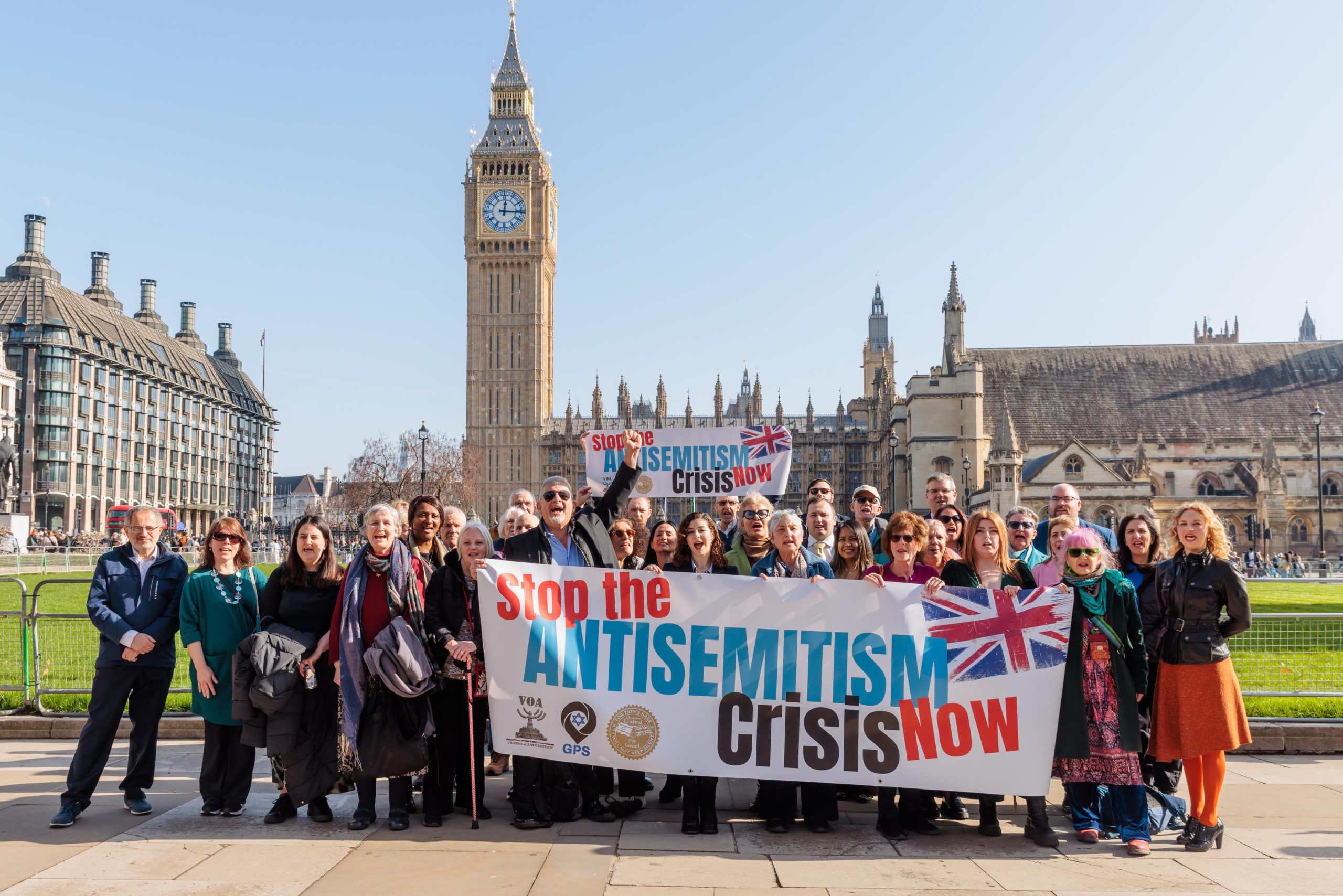
This effort has brought together over 400 Jewish groups in the GPS Network, alongside organisations such as Victims of Antisemitism and Christian networks, including Christians United for Israel. Their shared goal is simple but urgent: to confront antisemitism directly and demand effective action.
Recently, more than 80 victims and allies gathered at Parliament—not as lobbyists or spokespeople, but as individuals with lived experience. They met MPs from across the UK, urging immediate recognition of the crisis and concrete responses. The impact was profound. Victims spoke candidly about their experiences—fear, abuse, isolation, and violence—bringing statistics to life in deeply human terms.
These accounts revealed a disturbing pattern: children facing abuse in schools, families threatened in places of worship, professionals targeted at work, and students assaulted on campuses. Many described altering their behaviour, hiding their identity, or fearing for their safety in ways that were once unimaginable in modern Britain.
Jewish community leaders have heard many platitudes before: “We need to do more… this must mark a turning point… we have taken some important initial steps.” I
Last summer, a very senior Jewish community figure told us of politicians: “We are hitting our heads against a brick wall.”
Many of us in the grassroots Jewish and Christian communities have decided that while we wait for political leaders to get results, there might be another way to catalyse change: galvanise ordinary people — not their representatives. That is precisely what we have done.
In Parliament, we held crisis talks with constituency MPs from England, Scotland, Wales, and Northern Ireland, demanding they recognise the antisemitism crisis for what it is and act on it effectively and immediately. Outside, victims addressed their MPs directly. Inside, we held a mass lobby — more MPs came than expected.

Some victims sat with Health Secretary Wes Streeting MP and described the daily reality of unprovoked hatred: ostracism, false accusations, fear, violence. He was moved to tears. Literally.
Then, in the largest committee room in Westminster Palace — packed beyond capacity — GPS Network, CUFI, TV presenter Rachel Riley and Lord Daniel Finkelstein addressed the room. Priority was given to the victims. We heard harrowing first-hand accounts from ordinary Jewish people encountering this racism every day, across every part of the country. These are not statistics. They are people.
Rachel Riley put it plainly: “Behind soaring antisemitism statistics are real children, families, nurses, teachers — ordinary Jewish people experiencing levels of hate we’ve never known before in the UK. Regular Brits stand for fairness and equality. Were they to know the true extent of this crisis, they would demand something be done.”
Here are just a few of the stories we heard:
Lisa Lamkin, a local government worker from East London: “My son was abused for nearly two years at school, called ‘yid’ and ‘Jewish scum’. He was followed home by a child shouting, ‘f*** the Jews, kill the Jews’. The headteacher told my son to ‘be more resilient.'”*
Victoria, a recruitment manager from Ilford: “At my synagogue, people scream abuse at worshippers. My son’s bar mitzvah was ruined by someone hurling racial slurs. I had to teach my children an escape plan in case of an attack.”
Zoe, a waitress from Hastings: “I’ve had work events cancelled, death threats made to my face, been called a baby killer and a terrorist. I’ve had my religion removed from my medical records because I no longer feel safe having it there.”
Ryan, a social media manager from Manchester: “A colleague who knew I was Jewish made death threats, told me she was Hamas, and said she was going to gut me like a fish.”
Asher, a student from Bangor: “Since 7 October, I and members of my community have been physically assaulted multiple times. The only Jewish-owned business in my university city has been repeatedly vandalised — with no action from the CPS.”
Jeremy Wootliff from GPS Network & Victims of Antisemitism said: “British Jews are fed up with hiding behind higher walls, more cameras, more guards. We need to address the systemic root causes — immediately. The legislation already exists. Apply it. Strictly. Uniformly. Now. Believe Jews when we call out racism — we know what it looks like.”
Alastair Kirk from CUFI (Christians United for Israel) said: “To the UK’s Jewish community, you are not alone. As Christians, we will stand with you shoulder-to-shoulder, until antisemitism is expelled from our midst. We are therefore pleased to partner with the GPS Network so that Christians and Jews can take meaningful action together, including putting forward new proposals that are timely and have real potential for change.”
Together, we complemented existing proposals from established organisations with new grassroots suggestions to push beyond what seems to be insufficient government action. Among our ten proposals: create an Independent Antisemitism Ombudsman, prosecute those who use Israel as a pretext to target Jews, and enforce existing anti-terrorism and anti-racism laws in full.
Representatives from the CST (Community Security Trust), UKLFI (UK Lawyers for Israel), Our Fight and others raised depressing issues related to the crisis.
Britain has become a cesspit of anti-Jewish racism. We are not waiting for the next COBRA meeting after the next antisemitic terrorist incident, followed by yet more promises of immediate action.
This is a critical hour — for the Jewish community, for our nation, for the values we share. We demand immediate outcomes.
At our first Parliamentary event, our new voices were loud and clear. The victims of anti-Jewish hatred have a message for our government: stop the antisemitism crisis. Now.
Community leaders emphasised that the issue is no longer just about isolated incidents but systemic failure. Existing laws, they argue, are not being enforced consistently or strongly enough. Their message is clear: the tools to address this crisis already exist—what is lacking is the will to use them effectively.
While the government seeks to appoint an anti-Muslim hostility ‘tsar’, it is the Jewish community that is eight times more likely to be racially attacked than the next most targeted demographic per capita.
Alongside raising awareness, the coalition has proposed practical measures, including stronger enforcement of anti-racism laws, accountability mechanisms, and new oversight structures to ensure action is taken. Campaigners are calling for an Independent Antisemitism Ombudsman, who will prosecute those who use Israel as a pretext to target Jews, and enforce existing anti-terrorism and anti-racism laws in full.
This moment, they argue, is critical—not only for the Jewish community, but for the country as a whole. The fight against antisemitism is ultimately about defending shared values of fairness, safety, and equality.
Their message to the government is direct and urgent: act now.