

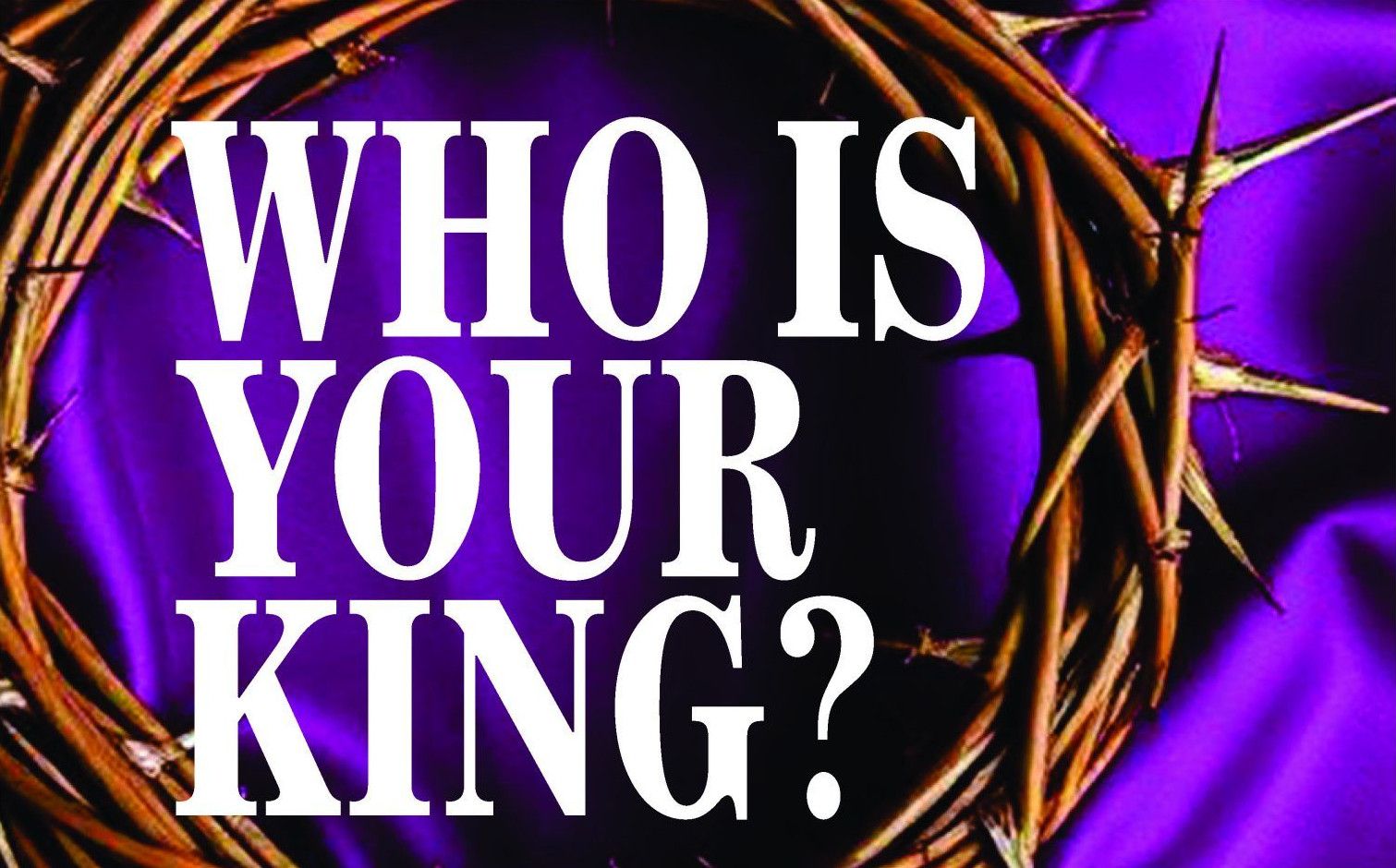
Amid war and chaos, we need a worthy leader
Picture this: a coronation procession with full pomp and hundreds of guests gathered to watch a bejewelled crown placed upon the head of a man.
Outside, many thousands more line his route to cheer. He is surrounded by soldiers whose mission is to protect his life from all harm.
Then picture a lonely, but public execution of a savagely whipped man, clad only in a crown of thorns that foreign soldiers have rammed on to his head. He is held in place on his stake by six-inch, dagger-like nails piercing his wrists and feet. He is mocked and taunted.
Pinned above his bloodied, crowned head is the title, ‘The King of the Jews’.
Yet this King’s followers, Jews and non-Jews alike, went on to change the world. They had the courage and zeal to do because they had witnessed the latest of many miracles performed by this man, whom they now believed was their Saviour and God, the King of Kings and Lord of Lords.
Risen from the dead
Jesus had risen from the dead; to this day his body has not been found. Other religions say his body was stolen by his disciples or he didn’t really die. The latter was impossible after an efficient Roman crucifixion; the medical evidence alone that is given in the Gospels confirms this.
Few of them died a natural death
If his disciples had stolen his body, what gave them the courage to preach boldly in the name of Jesus? Few of them died a natural death; most were executed (Peter, notably, was crucified upside down as he felt unworthy of the same means of execution as Jesus).
Jesus’ followers knew that God had been among them, living as they did, humbling himself to become a man: “He made himself of no reputation, taking the form of a bondservant, coming in the likeness of men” (Philippians 2:7).
How different that is to living under an authoritarian government, as millions around the world do. It is in countries where another system such as Communism or an extreme religious ideology dominates, that people turn to Jesus, the Servant King.
A monarch who serves his subjects
Jesus himself said that “the rulers of the Gentiles (non-Jewish people) lord it over them, and those who are great exercise authority over them…but whoever desires to become great among you, let him be your servant” (Mark 10:42)
What gave them the courage to preach boldly in the name of Jesus?
Our late Queen also vowed to serve her people all the days of her life, and her son, King Charles, has also been prepared from birth for a life of service and duty. Yet the unravelling of the Christian fabric of our nation, which began in his mother’s time, only seems to be accelerating.
Many asked the late Queen to call national days of prayer, as her father, King George VI, did in WW2. The Queen always declined, yet she had to give royal assent to laws that went against the faith she had sworn to uphold. If there was to be a day of prayer now, it would have to begin with deep repentance over the House of Lords’ vote to decriminalise abortion right up to birth, as well as thanking God that we have narrowly escaped the legalisation of assisted dying in Scotland and potentially in England.
The unravelling of the Christian fabric of our nation only seems to be accelerating
“Defend the faith”
King Charles is most unlikely to call a Christian day of prayer, yet the pleas for him to uphold his coronation vow to “defend the faith” continue, especially as his enthusiasm for Islam becomes more obvious. An open letter to the King from Bishop Ceirion H Dewar, of the Confessing Anglican Church, has been widely circulated. Bishop Ceirion states that “Christians across this land … feel that the spiritual inheritance of their nation is being surrendered without resistance. And they are asking whether the Crown will stand with them.”
He writes: “Christian morality is dismissed as intolerance. Christian institutions are pressured to surrender doctrine in order to conform to the ideology of the age. Within the very Church that bears the name of England, voices have arisen that appear more eager to mirror the spirit of the age than to proclaim the eternal truth of the Gospel.”
As St Paul wrote 2000 years ago, “There will be terrible times in the last days. People will be lovers of themselves, lovers of money, boastful, proud, abusive, disobedient to their parents, ungrateful, unholy, without love, unforgiving, slanderous, without self-control, brutal, not lovers of the good, treacherous, rash, conceited, lovers of pleasure rather than lovers of God.” (2 Timothy 3:1-4)
Little has changed, except the hopelessness that people are facing without Jesus becomes starker. With a seemingly unending war in Ukraine (with military experts predicting, nonsensically to some, a war with Russia), and a new war in the Middle East, both of which are making the cost of living soar, we are in troubled times.
Free speech crisis
We also have a free speech crisis; while people freely use the name of Jesus as a swear word, our leaders have imposed ‘guidance’ on anti-Muslim hostility, which will have an inhibiting effect on freedom of speech.
In troubling times, people usually seek God, and many Bible teachers believe that the God who is in control of the universe is shaking our country for this very reason.
A different type of king
Jesus reshapes people’s view of what a king looks like. He is a holy King, who laid his life down to pay the price for our sins. He came not for the healthy, but for the sick.
No earthly king or ruler can bring the peace of forgiveness and acceptance. Hence those who have been in the deepest pit, like Pippa Rafael (p12-13) who endured a childhood of abuse, yet knew what it was to be sustained and healed by Jesus. Now she wants everyone to meet him. If that is your choice, too, please pray the prayer on this page and open the door to inner peace and the assurance of eternal life with Jesus.
Let Jesus be your heavenly King.
Prince William’s “quiet” faith revealed
As if to calm the speculation over the Prince of Wales’s Christian commitment, the heir to the throne has let it be known that he has a “quiet faith” and “commitment to the Church of England”.
William’s comments came in the week before he was due to attend the new Archbishop of Canterbury’s enthronement. The Sunday Times reported that a source close to him had said that clarifying his belief was “a drawing of a line in the sand of where he’s at”.
The source added that the prince may not be a regular churchgoer, but “believes in” the Church and wants to support it. William sees the importance of the faith aspect of his role and “will take it very seriously in [his] own way”.
William and Catherine had also had tea with Sarah Mullally, the new Archbishop, in February; an aide described the conversation as “warm and substantive”. Apparently it helped that Archbishop Sarah is also an Aston Villa fan.