

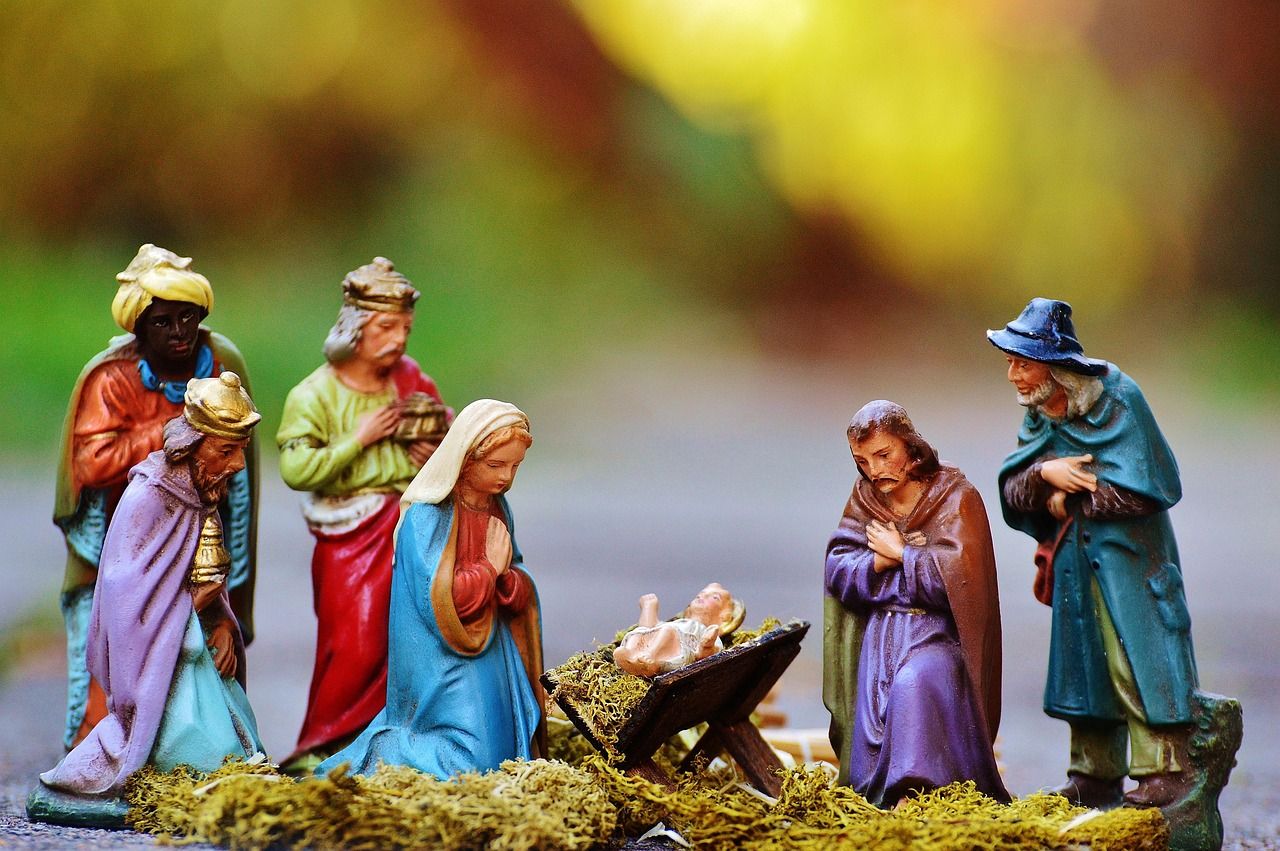
Bible teacher John Allen-Piper reveals why Jesus was actually born in a sheep tower and hard stone manger – and why was he wrapped in a high priest’s undergarments?
We love our Christmas cards showing a wooden stable and rickety manger, with just three kings hovering nearby, but the facts of his birth put paid to some of our cherished myths. Just as two millennia after Jesus’ birth, some now doubt that it actually happened, every aspect actually fulfilled the Bible’s messianic prophecies with divine precision.
Tea towel clad shepherds and tinsel topped angels, Mary and Joseph clutching a bundled up baby doll and a lisping rendition of ‘Away in the Manger’ depict the classic childhood nativity. Yet what was it really like for an unmarried pregnant teenager in Judea?
How Mary escaped being stoned
A first century Jewish engagement was a very different affair to today. Joseph would have paid the endowment price for Mary (Miriam was her actual name) and she would then be reserved for him. He would have built a marriage home before returning to claim her at the wedding ceremony. Mary had to anticipate his return at any time and keep a candle in a window confirming her reservation and expectation. What a beautiful picture of the Bride of Christ awaiting his return.
When Mary was found to be pregnant, she would have been liable to judgement by stoning under the ancient law. But Joseph loved her and “desired to put her away privately”. However, following a visit by an angel, who told him the baby’s name was to be Jesus (‘Yeshua’ in Hebrew, meaning ‘salvation, God saves’) and assured him that the baby was conceived by the Holy Spirit, Joseph took Mary as his wife and was not intimate with her until after the baby’s birth. But a betrothed couple returning home with a new baby would have meant Jesus probably grew up under the stigma of illegitimacy, as seems to be prophesied in Psalm 69 and indicated by the religious Pharisees in John 8:33-39.
A second Elijah
In the meantime, another miraculously conceived baby was also born, this one to elderly parents Zacharias and Elizabeth. Just as the angel spoke to Joseph about the name destined for his first son, so Zacharias was told to name his first son ‘John’ (‘Yochanan’), meaning ‘God is gracious’. John the Baptist fulfilled the prophecies that a man would come “in the power of Elijah” to bring comfort to Israel (Isaiah 40:1) and herald the birth of the Messiah: “Behold, I will send you Elijah the prophet before the coming of the great and dreadful day of the Lord” (Malachi 4:5).
A ruling by a distant Roman ruler at this precise moment in history led to the fulfilment of the prophecies surrounding the birth of Jesus
The very important “little town of Bethlehem”
The census decreed by Caesar Augustus required Joseph and Mary, both from the tribe of Judah, to register in Bethlehem, the city of their ancestor King David. So a ruling by a distant Roman ruler at this precise moment in history led to the fulfilment of the prophecies surrounding the birth of Jesus.
This led to a cascade of prophetic fulfilment. Micah declares Jesus’ birthplace to be Bethlehem Ephratah: “Thou, Bethlehem Ephratah, though thou be little among the thousands of Judah, yet out of thee shall come forth unto me He that is to be ruler in Israel; whose goings forth have been from of old, from everlasting” (Micah 5:2). Bethlehem was the home of Boaz (‘By strength’), who acted as the ‘kinsman redeemer’ to the gentile Ruth when he married her and restored her mother-in-law, Naomi’s inherited land. Ruth would become great grandmother to King David. Bethlehem means ‘House of bread’ and here Jesus, whom the apostle John calls the “bread of life” (John 6:32-33) would be brought forth
Thus both the first and last men from the kingship line of Judah, David and Jesus, were born in Bethlehem.
A very special stone stable
Ephratah was a farmed area a mile north of the town and contained a sheep enclosure, called by King David “Migdal eder”, where lambs were bred for Temple sacrifice. The name “Migdal eder” means “the watchtower of the flock”; these watch towers are still visible today. They comprised two storeys, the upper for watchmen to guard against predators and the lower comprising a stable where the sheep would be taken to carefully give birth to their lambs, thus perfectly fulfilling another prophecy: “To you, O tower of the flock, the stronghold of the daughter of Zion, to you shall it come, even the kingdom of the daughter of Jerusalem” (Micah 4:8).
When each new lamb was born, it would be wrapped in priestly undergarments and laid in a stone manger to prevent damage
These sheep had to be tended well to ensure they remained unblemished. As each festival approached, priests would come out to the farm carrying swaddling clothes. These were the undergarments of the High Priest which had been worn just once, for a festival. When each new lamb was born, it would be wrapped in these priestly undergarments and laid in a stone manger to prevent damage as it sought to find its feet.
Not just any shepherds
The shepherds, normally the lowest stratum of society in those days because they spent their lives with animals, were in this case Levitical shepherds and would be the first people to be given the revelation of the birth by angelic visitation.
“The priests have just come and collected an unblemished lamb for use in the festival tomorrow, so there will be a vacant manger there!”
When, exhausted, Joseph and Mary reached Bethlehem, they would not have been welcome at the inns because Mary was about to give birth and the shedding of a stranger’s blood would have defiled the house under Jewish law. Most likely a harassed innkeeper would have told them, “You can’t stay here but if you go a mile up the road towards Jerusalem you will find a special stable where they carefully birth lambs for use in the Temple. The priests have just come and collected an unblemished lamb for use in the festival tomorrow, so there will be a vacant manger there!”
So the parents-to-be went to the tower of Migdal eder so that Jesus, the ultimate perfect sacrificial lamb, would be born in the stable reserved for the Temple’s sacrificial lambs. Like the lambs, he was wrapped in swaddling clothes – the high priest’s undergarments – and placed in a stone manger.
Jesus’ birth date
The early Church celebrated John’s birth date on the appointed time of Passover appropriately with its theme of redemption as the first of the ‘mo’edim’, ‘fixed appointments’. Since every move in God’s timetable of redemption has occurred on a biblical appointed time, it is likely that Jesus was conceived by the Holy Spirit during the winter’s eight-day Feast of Chanukah, the eighth festival in the Jewish religious calendar.
Chanukah is the “Festival of lights” and Jesus is the ‘Light of the world’. He would then be born during the autumn fruit festivals, including the seventh festival, Tabernacles, when according to John’s Gospel “He tabernacled amongst us”.
There weren’t three kings
The Magi were actually a small army of turban-clad sages on white horses, the kingmakers of the Middle East, who heralded from Daniel’s time in Babylon. No wonder King Herod was terrified when they arrived with their retinue and costly gifts.
Seeing the story afresh
This Christmas, as we attend nativity plays, open cards depicting the baby Jesus lying in a rickety wooden manger and sing the age-old carols, let’s wonder anew at the beautiful plan God made, down to every last detail, to deliver us from our sins and demonstrate his great love to us.
 John Allen-Piper, an environmental scientist, ministers to Christian fellowships in the north of England and is author of ‘Creation Unlimited: the Remarkable Convergence of Science and the Bible’.